
Published October 12, 2026
AnyPS5 vs Emulators: What's the Real Difference?
A relinker is not an emulator. Here is what AnyPS5 actually does differently from projects like KyTyPS5 — and why it matters.
Every headline about AnyPS5 calls it a "PS5 emulator," and every one of those headlines is wrong. The project itself is careful about this: AnyPS5 is a relinker, not an emulator. The difference is not marketing — it is a completely different engineering approach, and understanding it explains both why the project is exciting and why it is still so early.
What an emulator does
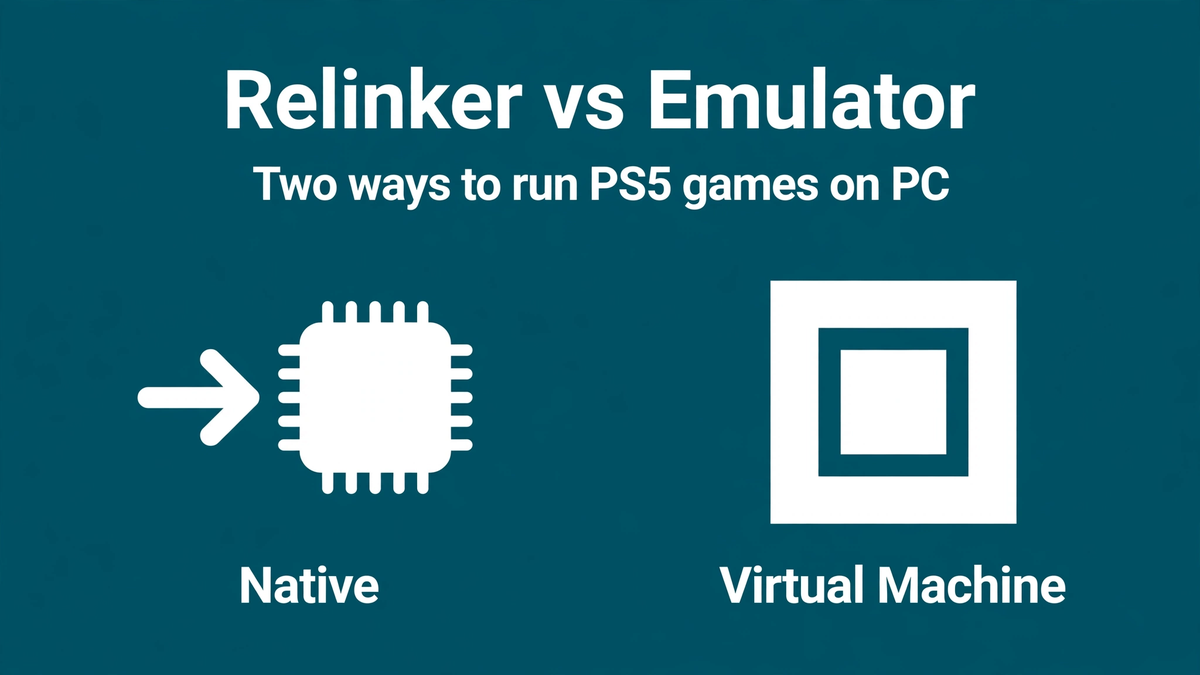
A traditional emulator builds a virtual version of the console inside software. Projects like KyTyPS5 recreate the PlayStation 5's hardware behavior — its processor, memory layout, system services — and then run the game inside that imitation. The game believes it is on a PS5; the emulator translates everything in real time.
This approach is general: in theory, one good emulator can run many games. But the cost is brutal. Emulating modern hardware accurately enough for games to run, at full speed, on a PC is one of the hardest problems in software. Every CPU instruction, every GPU command, every system call has to be intercepted and reproduced. That is why PS5 emulation is still in its infancy despite years of work.
What AnyPS5 does instead
AnyPS5 skips the imitation. The PlayStation 5's processor is an AMD Zen 2 chip speaking x86-64 — the same language as the processor in your gaming PC. So most of a game's actual machine code can run on your CPU directly, with zero translation.
What the game cannot do directly is talk to the PlayStation operating system. So AnyPS5 does two things: the relinker rewrites the game's PS5 executable into a native Windows or Linux binary, and the project's reimplemented system libraries stand in for the PS5 OS functions the game calls. Graphics shaders get converted to SPIR-V and rendered through Vulkan. The result is not a PS5 game running in something — it is a PC program, running natively.
Why the difference matters
Performance is the big one. An emulator pays a translation tax on everything. A relinked game pays almost nothing on CPU work, because the CPU code was already in the right language. If AnyPS5 matures, its performance ceiling is far higher than any emulator's — native code on native hardware.
The trade-off is breadth. An emulator aims at the whole console at once. AnyPS5 has to reimplement the PS5's system libraries function by function, and each game needs the specific functions it calls. That is why, months into the project, the verified compatibility list is one small indie game: the approach is narrow and deep, and depth takes time.
Which approach wins?
Neither, yet. Emulators like KyTyPS5 are further along in the "runs real games badly" phase; AnyPS5 is further along in the "elegant idea, tiny compatibility" phase. They are complementary bets, not rivals — and both are worth watching. For the current state of what actually runs, see our AnyPS5 compatibility status page, and for the project's direction, what's next for AnyPS5.